



How Genipin Powder enhances the durability of biomaterials?
Genipin Powder, a natural crosslinker, improves biomaterial durability and performance. Enzymes break down this white crystalline material from Gardenia jasminoides fruit. It naturally combines with amino groups in proteins and polymers to form stable covalent bonds that strengthen, make the material enzyme-resistant, and prolong material life. HPLC verified Genipin Powder, a biocompatible alternative to toxic synthetic crosslinkers, as 98% pure. It is beneficial in cosmetics, tissue engineering, and pharmaceuticals.
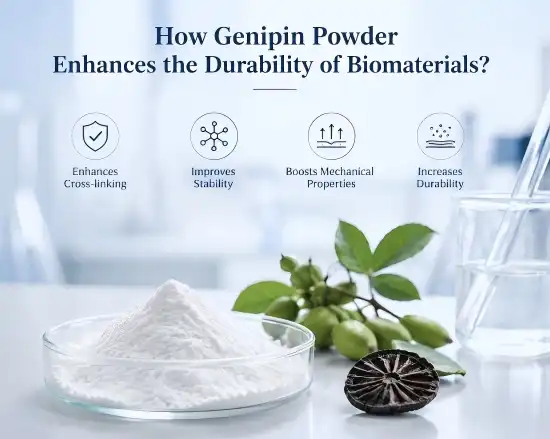
Understanding Genipin Powder and Its Role in Biomaterials
Genipin Powder from gardenia fruit advances natural bonding technology. Glutaraldehyde and formaldehyde, which damage cells, are 5,000 to 10,000 times more hazardous than this plant-based chemical. It solves a big business issue.
Chemical Structure and Crosslinking Potential
Genipin Powder reacts as C11H14O5. The aldehyde group in its iridoid form naturally binds to protein primary amines, especially lysine and hydroxylysine residues. This procedure works well at pH 7.0–8.5. It forms strong intermolecular connections and dark blue pigments. Because it melts at 120–124°C and dissolves largely in dimethyl sulfoxide and methanol and just a little in ethanol and water, it may be employed in many formulations.
Safety and Regulatory Standing
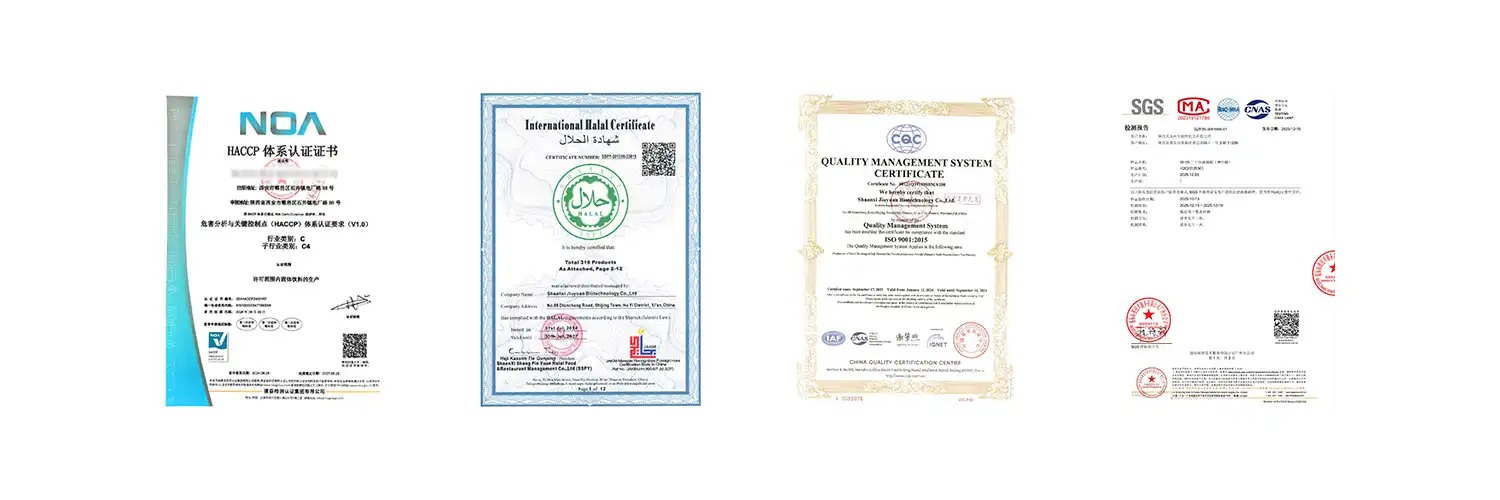
Quality management is crucial in biomaterial production. We have ISO9001, GMP, FDA registration, Kosher, and Halal certificates for our Genipin Powder. Each batch undergoes a rigorous HPLC examination to ensure moisture content stays below 1% and geniposide is limited to achieve the greatest crosslinking density. Buying teams receive a clear Certificate of Analysis with each product, meeting EU and US regulations. This accreditation provides beauty and medication firms peace of mind that their goods satisfy international safety requirements. This reduces the danger of breaking regulations in complex marketplaces.
How Genipin Powder Enhances Biomaterial Durability: Mechanism and Benefits
What sets Genipin Powder apart from other agents is its bonding mechanism, which extends product life and reduces expenses.
Molecular Crosslinking Process
Genipin Powder begins nucleophilic addition with collagen, gelatin, and chitin amino groups. Covalent linkages form three-dimensional networks that hold the structure together. Based on desired material properties, crosslinking density increases progressively with concentration, generally between 0.1% and 1.0% weight/volume. As opposed to manufactured solutions that need harsh catalysts or high pH levels, this natural agent works well in moderate physiological settings to preserve protein structure and reduce denaturation.
Biocompatibility Advantages
Regular cell viability assays demonstrate Genipin Powder maintains over 90% of cells alive at working levels. This differs from glutaraldehyde-treated materials, which kill over 50% of cells. The binding agent is natural, and there are no toxic byproducts, making it biocompatible. Histological study reveals implants heal correctly, and tissue response tests show minimal inflammatory indicators. This natural chemical promotes angiogenic activity, which facilitates tissue integration. This reduces biomedical device encapsulation and enhances vascularization. Due to its many features, this natural crosslinker is ideal for organizations creating next-generation polymers that must be robust and biocompatible.
Procurement Considerations for B2B Clients: Choosing the Right Genipin Powder
To pick the proper crosslinking agents, check their technical characteristics, supplier background, and supply chain reliability. Procurement professionals make several decisions that impact product performance and operating speed.
Purity and Quality Specifications
Genipin Powder used commercially is 90%–99% pure. For biological purposes, 98% purity is standard. Higher purity levels stabilize Genipin Powder crosslinking processes and reduce batch-to-batch variability. HPLC testing shows that our 98% pure product includes little geniposide, a precursor that doesn't crosslink. Quality assurance tests should include heavy metals, microbiological contaminants, and residual liquids. Certificates of Analysis that indicate these elements are crucial for tracking, especially when creating FDA-regulated products or GMP-compliant pharmaceuticals.
Supplier Certification and Transparency
Supplier trust for Genipin Powder is crucial to long-term success. Look beyond pricing to check how many certifications the firm has for Genipin Powder. ISO9001, FDA certification, and SGS evidence demonstrate quality management systems for Genipin Powder. Our factory preserves detailed records on gardenia growth, extraction, and cleaning of Genipin Powder. This unambiguous chain-of-custody helps importers comply with customs and fulfills public company due diligence requirements for Genipin Powder. Private label and co-development let businesses differentiate while leveraging current supply networks for Genipin Powder
Purchasing and Logistics: Streamlining Your Genipin Powder Sourcing
Buying efficiently goes beyond selecting the proper things. It also covers practical methods for Genipin Powder purity and delivery schedules.
Sourcing Channels and Pricing Structures
Direct producer partnerships generally give better costs than distribution networks for pledges over 100 kg per year. Clear price plans account for purity, packing, and delivery timeframes. We quote EXW, FOB, CFR, CIF, DAP, and DDP. This allows buying teams to discover the best landing prices using their transportation expertise. Wire transfer (T/T) is still the most common payment method since it is safe and easy to follow, unlike credit cards. For easier planning, annual contracts lock in rates, and price stability provisions safeguard against raw material variations.
Sample Protocols and Testing
Pre-purchase samples lessen formulation risks. Our 50–100 gram samples come with analytical papers so you may test for appropriateness before ordering in bulk. Samples are returned by air freight in 5–7 business days, and DHL and FedEx deliver quickly to North American and European labs. Third-party lab tests corroborate our internal standards. This provides external validation for quality control teams and regulatory filings.
Inventory and Lead Times
Our 4,000–5,000-square-meter warehouse stocks a lot of natural crosslinkers to fulfill regular requests quickly. Large purchases ship in 15 business days, while urgent orders are processed faster. Production capacity may be changed to match seasonal demand without compromising quality. Our client platform gives procurement planners real-time inventory levels. This helps them match orders with manufacturing plans, reducing carrying costs and stockouts.
Future Trends and Innovations in Genipin-Enhanced Biomaterials
Biomaterials are becoming more biocompatible, sustainable, and functionally complex. These developments are increasing the demand for natural bonding.
Expansion into Medical Device Markets
More regulatory approvals prefer biodegradable products with proven safety ratings. Natural Genipin Powder contains much safety data, making it a viable choice for novel medical device usage. Genipin Powder is used in crosslinker-containing orthopedic implant coatings to improve osseointegration, reducing hip and knee replacement failures. It helps preserve corneal transplants by keeping tissue patches clean and enzyme-resistant with Genipin Powder. Crosslinked polymer architectures on cardiovascular stents prevent clotting while bending around convoluted channels using Genipin Powder.
Biodegradable Polymer Composites
Environmental concerns inspire biodegradable packaging and single-use medical items. Genipin Powder combined with PLA or PHA creates biodegradable materials as robust as petroleum-based polymers. These materials break down predictably in landfills and rubbish piles, yet stay together when utilized. Crosslinked plant proteins in functional food packaging repel moisture and kill bacteria without artificial additives, which clean-label customers seek.
Regulatory Landscape Evolution
Tighter limits on man-made chemicals, notably cancer-causing aldehydes, accelerate the switch to natural solutions. Natural crosslinkers gracefully circumvent EU REACH and California Proposition 65 warnings. Sustainable and safe procurement techniques provide brand owners with an edge when dealing with customer scrutiny and regulatory regulations. Our extensive certifications placed our clients at the forefront of this regulatory transition, protecting supply lines from future constraints that may render synthetic rivals ineffective.
Conclusion
Natural crosslinking extends biomaterial lifespan as a technique and strategy. Genipin Powder improves mechanical strength, enzyme resistance, biocompatibility, and safety compared to synthetic choices. Purchasers may find a certified, stable natural crosslinker that fulfills medical device, cosmetics, and pharmaceutical regulations. Once sustainability, biocompatibility, and performance are met, this gardenia chemical becomes a key building block for biomaterial development. Strategic procurement agreements based on transparency, quality assurance, and technical assistance enable manufactures speed up innovation, stay compliant, and compete on price in shifting global marketplaces.
FAQ
1. What concentration of Genipin Powder is recommended for biomaterial crosslinking?
Between 0.1% and 1.0% weight/volume is optimal depending on mechanical properties and substrate type. Chitosan hydrogels may require 1.0% solutions, while collagen supports usually utilize 0.5%. Crosslinking density is also impacted by response time. Materials exposed to room temperature air for 24–48 hours form a full network without coloring.
2. How does this natural crosslinker compare to glutaraldehyde in durability enhancement?
Glutaraldehyde crosslinks quickly, while Genipin Powder mechanically strengthens with 5,000–10,000 times less cytotoxicity. Reaction periods are 24 hours against 2–4 hours for glutaraldehyde, but lifespan is gained. This disparity is offset by biocompatibility in biological contexts.
3. Can I request product samples before committing to bulk orders?
We provide 50-100 gram samples and professional papers like HPLC purity reports and Certificates of Analysis. Air freight delivers sample requests in 5–7 business days. This process allows R&D teams to evaluate novel formulations for compatibility and stability before mass production.
Partner with HERBCOSHER for Premium Genipin Powder Supply
Manufacturers seeking a reliable Genipin Powder provider can choose from HERBCOSHER's vertically integrated services. With over 20 years of extraction experience and relationships with Northwest A&F University and Northwest University, we can guarantee 98% pure items through HPLC testing. Our ISO9001, FDA, Kosher, and Halal certifications provide legal security for pharmaceutical and cosmetic firms. Our 4,000-square-meter warehouse makes it easier to finish large orders in 15 days.
Our OEM/ODM services include recipe creation, liposome and microcapsule dosage forms, and brand-specific private label solutions. Beyond normal packaging, customization is possible. Flexible delivery terms such as EXW, FOB, CIF, and DDP satisfy different logistics needs. Global supply chains are protected by temperature-controlled transportation. Discuss your biomaterial demands with our technical staff at info@herbcosher.com and receive detailed quotations with third-party test results.
References
1. Butler, M.F., Ng, Y.F., and Pudney, P.D. (2003). "Mechanism and kinetics of the crosslinking reaction between biopolymers containing primary amine groups and genipin." Journal of Polymer Science Part A: Polymer Chemistry, 41(24), 3941-3953.
2. Sung, H.W., Huang, R.N., Huang, L.L., and Tsai, C.C. (1999). "In vitro evaluation of cytotoxicity of a naturally occurring cross-linking reagent for biological tissue fixation." Journal of Biomaterials Science, Polymer Edition, 10(1), 63-78.
3. Mi, F.L., Tan, Y.C., Liang, H.F., and Sung, H.W. (2002). "In vivo biocompatibility and degradability of a novel injectable-chitosan-based implant." Biomaterials, 23(1), 181-191.
4. Touyama, R., Takeda, Y., Inoue, K., Kawamura, I., Yatsuzuka, M., Ikumoto, T., Shingu, T., Yokoi, T., and Inouye, H. (1994). "Studies on the blue pigments produced from genipin and methylamine." Chemical and Pharmaceutical Bulletin, 42(8), 1571-1578.
5. Tsai, C.C., Huang, R.N., Sung, H.W., and Liang, H.C. (2000). "In vitro evaluation of the genotoxicity of a naturally occurring crosslinking agent (genipin) for biologic tissue fixation." Journal of Biomedical Materials Research, 52(1), 58-65.
6. Yuan, Y., Chesnutt, B.M., Utturkar, G., Haggard, W.O., Yang, Y., Ong, J.L., and Bumgardner, J.D. (2007). "The effect of cross-linking of chitosan microspheres with genipin on protein release." Carbohydrate Polymers, 68(3), 561-567.